The EU has approved a major reform of its customs framework, Regulation (EU) 2026/2108 repeals and replaces the current Union Customs Code (Regulation (EU) No 952/2013) with a redesigned framework. The aim is to create more modern, digital customs processes, strengthen enforcement against unsafe/non-compliant goods, and improve the way customs duties are collected especially for e-commerce.
What’s changing
1) E-commerce platforms become the “importer”
For many e-commerce sales into the EU, non-EU online platforms/marketplaces will be treated as the importer of record, meaning they not the EU consumer are responsible for customs formalities, duty payments, and compliance.
2) Tougher enforcement and penalties
Operators that fail to meet obligations may face penalties, loss of simplifications, and where serious fines of up to 6% of annual import value (prior year) plus potential platform access restrictions.
3) An EU-wide handling fee for e commerce packages
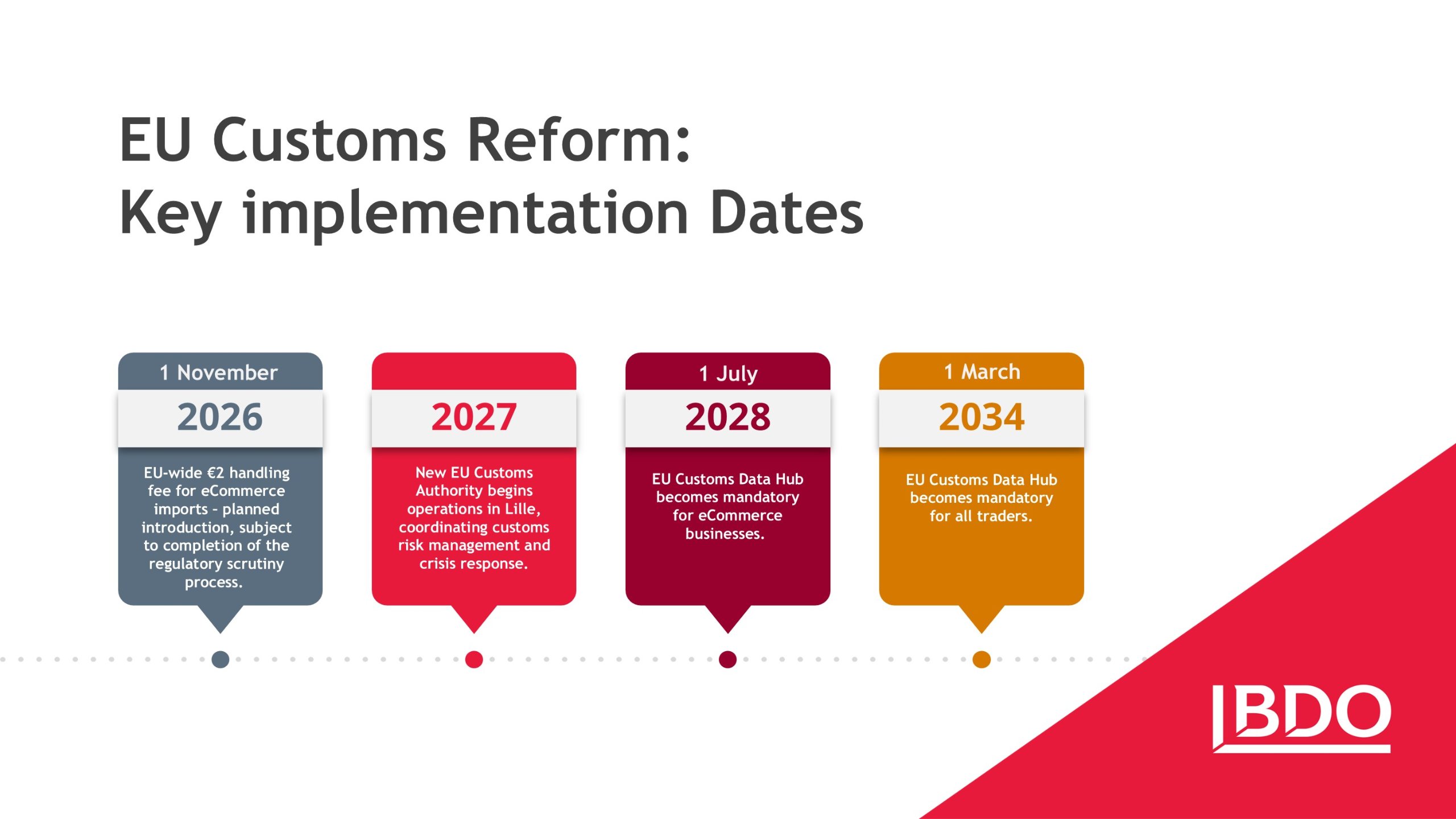
An EU-wide handling fee on e commerce parcels is expected by 1 November 2026, separate from the removal of the €150 duty exemption.
European Commission Delegated Regulation C (2026)6694 adopted on 21 September 2026 introduces a new €2 handling fee on e‑commerce/distance‑sale goods imported into the European Union from non‑EU countries.
The Delegated Regulation supplements Regulation (EU) 2026/2108 (the revised Union Customs Code) and is intended to offset the digital and administrative costs associated with customs supervision of distance sales.
Key points include:
- A flat €2 fee per item (or tariff line) for ecommerce consignments entering the EU.
- The €2 handling fee is in addition to the €3 flat customs duty introduced earlier in 2026—so international shipments may incur up to €5 in flat customs charges, before VAT is applied.
- The fee is payable by the customs declarant.
As an adopted delegated act listed in the Register of Commission Documents, it is subject to a scrutiny period by the European Parliament and the Council prior to formal publication and implementation.
4) New EU Customs Authority and a single EU Customs Data Hub
A new EU Customs Authority (from 2027, based in Lille) will coordinate risk management and crisis response, powered by a central EU Customs Data Hub.
5) Faster customs for the most reliable traders
A new “trust and check” category will offer simplified procedures and potentially release of goods without active intervention, for businesses meeting strict transparency and compliance standards.